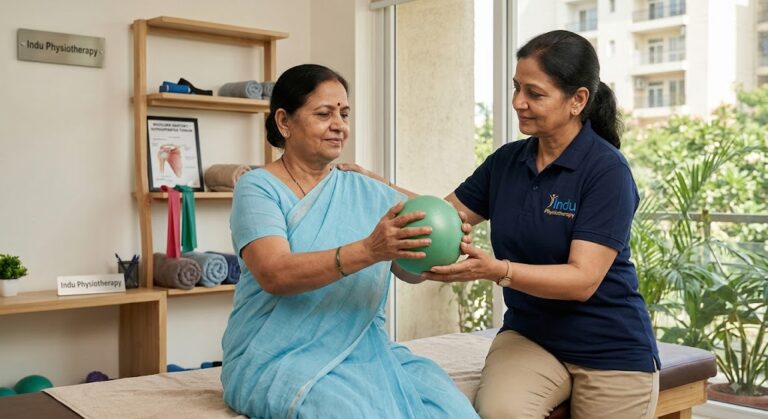
Shoulder pain that worsens when lifting your arm, reaching overhead, or trying to sleep on your side is often a sign of supraspinatus tendinitis. As one of the most common rotator cuff injuries, inflammation of the supraspinatus tendon can severely restrict your mobility and disrupt daily life.
At Indu Physiotherapy Clinic in Gurgaon, we offer evidence-based, non-surgical rehabilitation tailored to restore your shoulder mechanics, relieve pain, and help you get back to an active lifestyle.
[ Shoulder Joint Structure ]
│
┌───────────────┴───────────────┐
▼ ▼
[ Acromion Bone ] [ Rotator Cuff ]
│ │
└───────► [ Subacromial ] ◄─┘
[ Space ]
│
▼
[ Supraspinatus Tendon ]
The supraspinatus is a critical muscle in your rotator cuff, responsible for initiating arm abduction (lifting your arm sideways). Because its tendon passes through a narrow arch beneath the acromion bone (subacromial space), it is particularly prone to friction, micro-tears, and inflammation due to repetitive overhead motion or structural impingement.
Repetitive Overhead Activity: Frequent pitching, swimming, badminton, tennis, or overhead weightlifting.
Occupational Stress: Long hours of desk work with rounded shoulders, or manual labor requiring constant reaching.
Postural Imbalances: Forward head posture and slumped shoulders narrow the subacromial space.
Age-Related Wear & Tear: Natural decrease in tendon vascularity and elasticity over time.
| Symptom | Description | Impact on Daily Life |
| Pain Arc | Sharp pain when lifting the arm between 60° to 120°. | Difficulty combing hair or reaching upper shelves. |
| Night Pain | Throbbing pain when lying directly on the affected shoulder. | Poor sleep quality and fatigue. |
| Rotator Cuff Weakness | Reduced strength when elevating or rotating the arm. | Inability to carry heavy groceries or lift objects. |
| Shoulder Stiffness | Tightness around the back or front of the shoulder joint. | Difficulty dressing or reaching behind your back. |
Our physical therapy approach addresses both immediate pain relief and long-term joint stability.
┌─────────────────────────────────────────┐
│ PHASE 1: Acute Pain & Relief │
│ • Ice therapy & gentle electrotherapy │
│ • Activity modification │
└────────────────────┬────────────────────┘
│
▼
┌─────────────────────────────────────────┐
│ PHASE 2: Mobility & Joint Mechanics │
│ • Manual therapy & soft-tissue release │
│ • Passive & active-assisted stretches │
└────────────────────┬────────────────────┘
│
▼
┌─────────────────────────────────────────┐
│ PHASE 3: Rotator Cuff Strengthening │
│ • Isometrics ➔ Resistance bands │
│ • Scapular stabilization exercises │
└────────────────────┬────────────────────┘
│
▼
┌─────────────────────────────────────────┐
│ PHASE 4: Return to Sport & Function │
│ • Sport-specific / work-specific drills │
│ • Posture & injury prevention training │
└─────────────────────────────────────────┘
Manual Therapy & Joint Mobilization: Hands-on joint gliding to expand the subacromial space and reduce stiffness.
Targeted Dry Needling / Soft Tissue Release: Releases stubborn trigger points in the supraspinatus, upper trapezius, and infraspinatus muscles.
Scapular Stabilization Training: Strengthening the serratus anterior and lower trapezius to optimize shoulder blade movement.
Kinesiology Taping: Offers structural support and offloads tension from the inflamed tendon during early recovery.
Note: Consult our physiotherapists in Gurgaon before starting any exercise routine to ensure proper form and safety.
Pendulum Exercise: Lean forward, support yourself with your healthy arm, and let your affected arm dangle gently. Swing it slowly in small circles to promote joint lubrication.
Scapular Squeezes: Stand tall and gently squeeze your shoulder blades back and down. Hold for 5 seconds and release.
Isometrics for Abduction: Stand next to a wall, press the outside of your forearm against it gently without letting your arm move, and hold for 5–10 seconds.
Mild to moderate tendinitis usually responds well within 4 to 8 weeks of consistent physiotherapy and targeted home exercises. Chronic cases may take slightly longer.
Yes! Early and structured physiotherapy is highly effective for supraspinatus tendinitis, resolving symptoms without invasive procedures in the vast majority of cases.
Complete immobility can lead to shoulder stiffness or frozen shoulder. Controlled, pain-free movement guided by a physical therapist is key to optimal tendon healing.
Most oral emergencies relate to pain, bleeding, or thoracic pain and should be attended by a Physiotherapist.
We will send you a confirmation within 24 hours. Emergency? Call +91-9289 059 265
Most oral emergencies relate to pain, bleeding, or thoracic pain and should be attended by a Physiotherapist.